Drinkware Quality Comparison
What is glass?
Best Drinkware Quality Comparison Humans use glass in daily life for thousands of years. Manufacturers make it by melting sand, soda ash, and limestone at very high temperatures, usually 1,400°C to 1,600°C. Workers then shape the molten mixture into different forms for household or industrial use. Additionally, manufacturers add minerals such as silica, barium, and metal oxides to improve strength, clarity, color, and heat resistance. For example, silica increases hardness, barium enhances refractive properties, and other additives provide color or durability.
High-quality glass does not absorb liquids, odors, or stains. This feature makes it hygienic, easy to clean, and resistant to bacteria. Moreover, many types of glass withstand high heat without cracking. They also remain dishwasher safe, which suits repeated daily use. Glass allows light to pass through with minimal distortion. Therefore, it works perfectly for windows, lenses, screens, and decorative items.
Manufacturers temper glass for extra strength, laminate it for safety, or coat it to block UV rays. Consequently, glass becomes highly useful in homes, offices, and industries. Its combination of durability, versatility, safety, and beauty makes it essential in construction, automotive, electronics, laboratories, and homeware. From elegant drinkware and decorative items to high-tech laboratory equipment and skyscraper windows, glass provides both functionality and aesthetic appeal.
What Is Crystal?
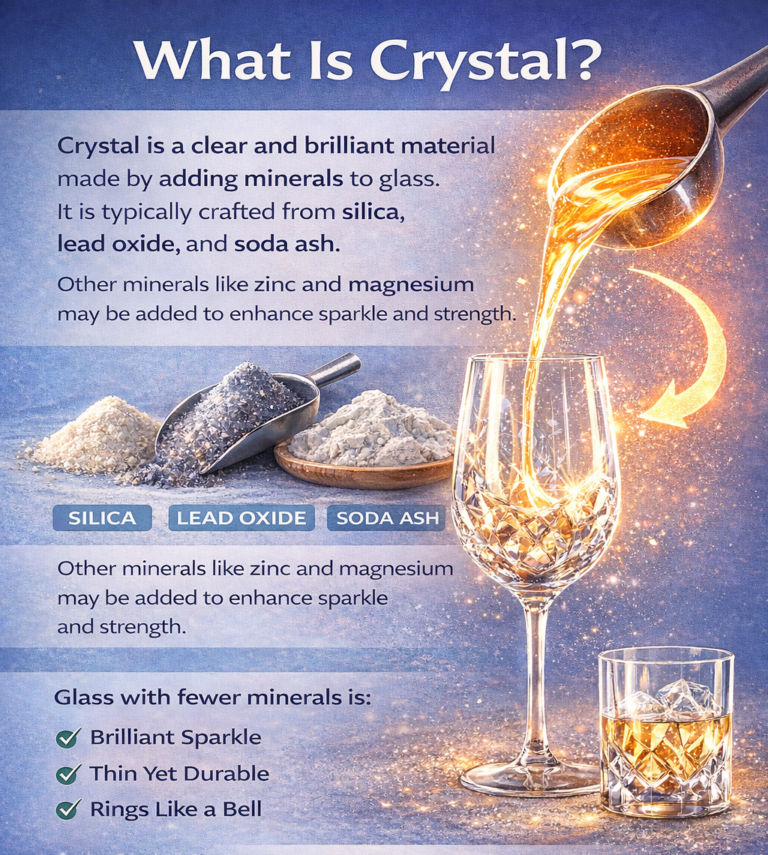
Crystal glass is a highly transparent and refined material that is manufactured using the same base ingredients as ordinary glass, including sand, soda ash, and limestone, but with the addition of lead oxide or other metal oxides. These added elements significantly improve the strength, flexibility, and workability of the material, allowing it to retain its shape and integrity even when it is intricately cut, engraved, or blown into thin and delicate forms. One of the most distinctive characteristics of crystal is its ability to refract and disperse light, which is enhanced by the presence of metal oxides. This property gives crystal its well-known brilliance, sparkle, and clarity, making it visually superior to standard glass.
Best Drinkware Quality Comparison Unlike what the name may suggest, crystal glass does not possess a true crystalline structure; instead, it remains an amorphous solid, similar to regular glass. Crystal is produced by manufacturers across the globe and is available in various grades, depending on the type and amount of metal oxides used in its composition. Some crystal contains lead oxide, while modern crystal often uses lead-free alternatives to meet safety and environmental standards. Due to its aesthetic appeal, weight, and refined appearance, crystal is widely used for premium drinkware, chandeliers, decorative objects, and luxury tableware. Renowned brands such as Nachtmann and Bohemia Crystal are known for producing high-quality crystal products that combine craftsmanship with elegance.